

Michael D Herman | August 9, 2026 | Car Accidents & Compensation
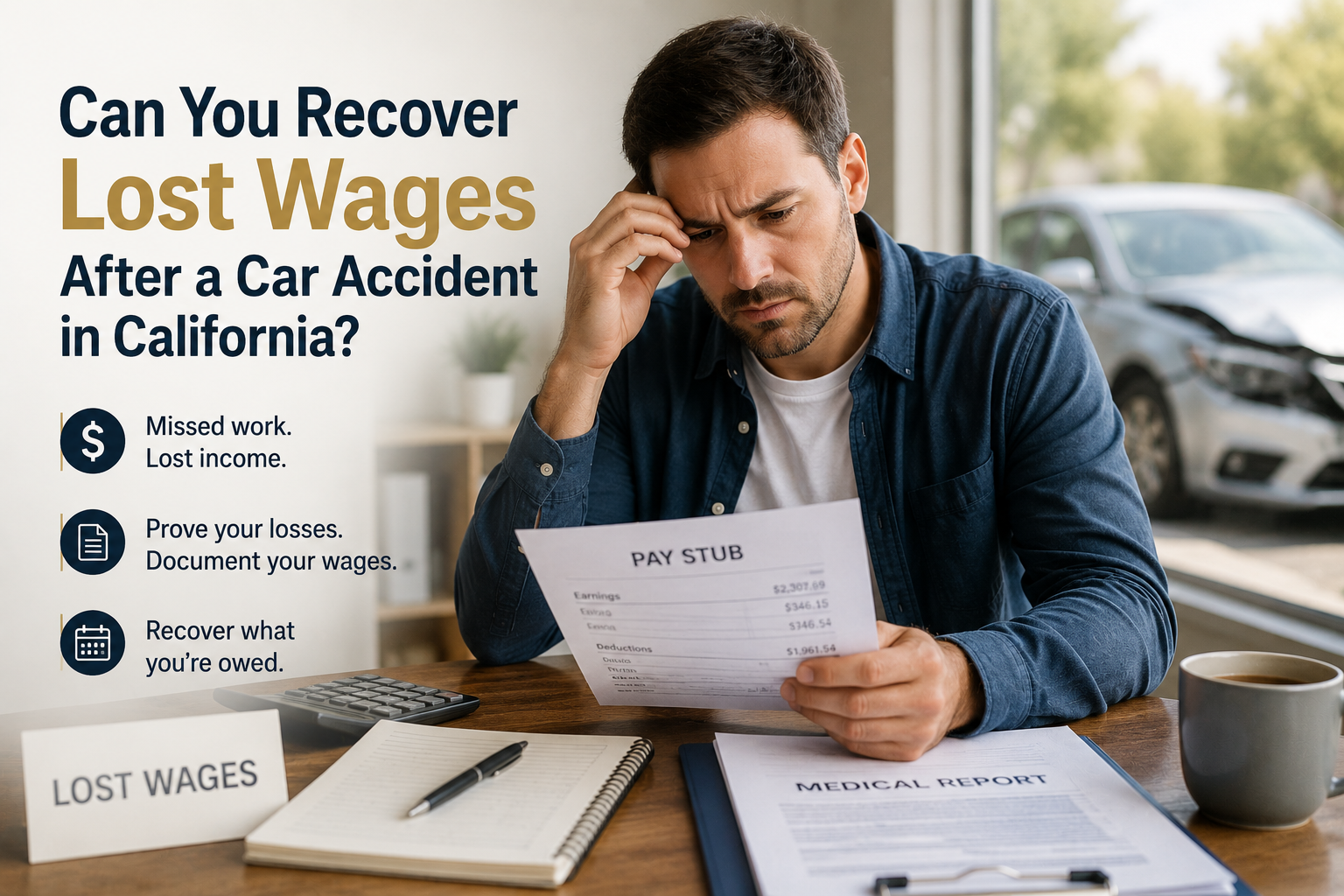
Can You Recover Lost Wages After a Car Accident in California?
You were hurt in a California car accident, and your doctor told you to stay home from work. Or maybe your injuries make it impossible to do your normal job duties, at least for now. Either way, the bills have not stopped coming just because your paycheck has.
Between medical treatment, vehicle repairs, missed shifts, burned-through PTO, and the general financial stress of not knowing when you can fully return to work, lost income is often one of the most immediate and stressful parts of recovering from a crash. The good news is that lost income can potentially be part of a California personal injury claim, when it is properly supported by evidence and applicable law.
In California, lost wages and lost earning capacity may be recoverable as economic damages after a car accident, provided the loss is connected to the accident-related injury and supported by adequate documentation. This can include hourly wages, salary, overtime, commissions, and certain bonuses, along with future earning losses in more serious cases. The specific amount recoverable depends on your employment situation, the strength of your documentation, and the applicable facts and law.
Can You Recover Lost Wages After a California Car Accident?
Generally, yes. California law recognizes lost wages as a potential category of economic damages in a personal injury claim. Under CACI No. 3903C, Past and Future Lost Earnings, an injured person may recover the amount of income, earnings, salary, or wages they have lost to date, and, in appropriate cases, the amount they will be reasonably certain to lose in the future as a result of the injury.
That said, recovering lost wages is not automatic. Generally, you need evidence connecting the lost income to your accident-related injury, and the amount claimed needs to be supported by appropriate documentation rather than an estimate. The specific facts of your employment situation, and the applicable law, both play a role in what can actually be recovered.
What Counts as Lost Wages After a Car Accident?
Depending on your employment situation and the available evidence, potentially recoverable lost income can include:
- Regular hourly wages
- Salary
- Missed workdays
- Reduced work hours
- Missed shifts
- Overtime you historically earned
- Commission income
- Certain bonuses
- Other employment income where legally supported
Not every category of compensation is automatically recoverable in every case. Whether a specific type of income can be claimed generally depends on the nature of your employment and whether you have evidence to support it, which is discussed in more detail below.
What Is the Difference Between Lost Wages and Lost Earning Capacity?
These terms are often used loosely, but they describe different things.
| Type | What It Generally Means |
|---|---|
| Lost wages | Income already missed because of the accident-related injury |
| Lost earnings | A broader term that can include income or earnings lost as a result of the injury |
| Lost earning capacity | A reduced ability to earn income going forward, whether or not you have returned to work |
This distinction matters because a person can potentially have a claim for lost earning capacity even after they have returned to work, if the injury has permanently affected their ability to earn what they could have earned before the accident. Under CACI No. 3903D, Lost Earning Capacity, a jury must find that the injury will result in a loss of earning capacity, and then assign a value by comparing what the injured person could have earned without the injury to what they can still earn with it.
What If You Used Vacation or Sick Days After the Accident?
This comes up constantly, and it is worth addressing directly. Using accrued paid time off, sick leave, or vacation days to cover time missed because of an accident-related injury does not necessarily mean you have not suffered a compensable loss. Paid leave is generally treated as a benefit you earned and would otherwise still have available. Using it because of someone else’s negligence is commonly treated as a real economic loss, and the value of that used leave can be part of a lost-wage claim.
This connects to a broader principle in California law known as the collateral source rule, established in Helfend v. Southern California Rapid Transit District (1970). Under this rule, a defendant generally cannot reduce what they owe simply because the injured person had the foresight to carry disability insurance, or had accrued PTO to draw from. That said, how PTO and sick-leave usage gets documented and valued can vary by employer and by the specific facts of a claim, so this is an area where an attorney’s evaluation of your specific circumstances can be genuinely useful.
How Do You Prove Lost Wages After a Car Accident?
California courts note that evidence such as doctor’s notes and pay records can help establish income loss in a personal injury case. A more complete evidence checklist generally includes:
- Pay stubs
- W-2 forms
- Tax returns
- Employer verification letter
- Payroll records
- Time sheets
- Attendance records
- Doctor’s work restrictions
- Medical records
- Employer statements
- Bank records, when relevant
- Employment contracts
- Commission statements
- Bonus records
- PTO and sick-leave records
What Should Your Employer Provide?
An employer verification letter is often one of the single most useful pieces of documentation in a lost-wage claim. A well-prepared letter generally addresses:
- Position and job title at the time of the accident.
- Pay rate, whether hourly, salaried, or commission-based.
- Normal work schedule before the injury.
- Hours and dates missed due to the accident-related injury.
- Overtime history, where applicable.
- Commission or bonus history, where applicable.
- Employment benefits affected by the absence.
- Return-to-work restrictions or accommodations, if any.
- Reduced hours since returning, if applicable.
How Do You Calculate Lost Wages?
The calculation method depends heavily on how you are paid.
Hourly Employee
Hypothetical example: $30 per hour × 40 missed hours = $1,200 in gross wages.
Salaried Employee
A salary is generally converted into an equivalent daily or weekly rate to calculate the value of the specific period missed. For example, an annual salary can be divided by 52 weeks to establish a weekly rate, which is then multiplied by the number of weeks missed.
Overtime Worker
Overtime that was regularly earned before the accident may require additional documentation, such as historical pay records showing a consistent pattern, to support its inclusion in a claim.
Commission-Based Employee
Historical earnings and commission statements often matter significantly here, since commission income can fluctuate and generally needs a documented pattern to support a reliable calculation.
Self-Employed Person
Income documentation for self-employed individuals is typically more involved, and is addressed in more detail below.
Can Self-Employed People Recover Lost Income After a California Car Accident?
Generally, yes, though proving the loss typically requires more detailed financial documentation than a traditional pay stub. Relevant evidence often includes:
- Tax returns
- Profit-and-loss statements
- Invoices
- Contracts
- Bank statements
- Bookkeeping records
- Appointment records
- Documentation of canceled work
- Other business records
- Historical revenue trends
It is important to understand the distinction between gross business revenue and the actual income or profit attributable to the injured person’s own work. Gross revenue does not automatically equal personal lost wages, since a business’s revenue often reflects the labor of employees, overhead costs, and other factors beyond the injured person’s individual efforts. A self-employed person’s claim generally needs to isolate what portion of that revenue reflects their own lost personal earnings.
What If You Work for Yourself or Own a Business?
Contractors, freelancers, consultants, real estate agents, small business owners, gig workers, and independent professionals often face a more complex documentation process than traditional employees. Because there is no employer to issue a verification letter, proving lost income generally requires assembling a more detailed financial picture, comparing historical earnings against the period affected by the injury, and sometimes involves accounting or vocational expert input in more significant cases.
Can You Recover Lost Overtime?
Potentially, yes, when the overtime was actually earned or is reasonably supported by historical records. Relevant considerations include:
- Previous overtime records showing a documented pattern before the accident.
- Employer records confirming overtime hours and rates.
- Consistent overtime history rather than occasional or one-time overtime.
- Scheduled overtime that was planned before the injury occurred.
- Industry or job requirements that made overtime a regular part of the role.
Speculative future overtime, meaning overtime that was not part of an established pattern, is generally not treated the same as overtime with a documented history.
Can You Recover Lost Bonuses or Commissions?
This depends heavily on the strength of the supporting evidence. Relevant factors include:
- Past bonus history showing a consistent pattern.
- Commission history over a meaningful period of time.
- Employment agreements that define bonus or commission structures.
- Performance records supporting the likelihood of the bonus or commission.
- Scheduled commissions tied to deals or sales already in progress.
- Employer documentation confirming the amount and basis for the payment.
Predictable, historically documented income is treated very differently than speculative future income that depends on uncertain future events.
What If Your Doctor Says You Can Work Only Part-Time?
Reduced hours, modified duties, and temporary work restrictions are common outcomes after a car accident injury, and they can create a real economic loss even when a person has technically returned to work.
Hypothetical example: Before the accident, a worker earned $1,000 per week working full-time. Their doctor restricts them to half-time work for eight weeks, reducing their weekly income to $500. The difference, $500 per week × 8 weeks = $4,000, may represent a documented loss for that period.
The difference between pre-accident and post-accident earnings, when supported by medical work restrictions and payroll records, can be a relevant part of a lost-wage claim.
What If You Cannot Return to Your Previous Job?
When an injury permanently affects someone’s ability to perform their previous job, this generally shifts the analysis toward lost earning capacity rather than simple lost wages. Relevant considerations can include:
- Physical limitations that prevent returning to the previous role.
- Cognitive limitations affecting work performance.
- Permanent work restrictions documented by a physician.
- Reduced overall work capacity, even in a different role.
- Career changes made necessary by the injury.
- Reduced earning potential compared to the pre-injury career trajectory.
- Vocational evidence, in more significant cases, from a vocational expert.
- Medical evidence establishing the connection between the injury and the limitation.
- Economic evidence quantifying the difference in earning potential.
Simply changing careers after an accident does not automatically create a compensable loss. The claim generally needs to show that the injury itself caused a genuine reduction in earning capacity, not just a personal decision to pursue different work.
Can You Recover Future Lost Income?
Potentially, yes, in appropriate cases. Under CACI No. 3903C, future lost earnings must be proven to a standard of reasonable certainty, meaning there must be enough evidence to show a degree of probability that the future loss will actually occur, rather than a purely speculative possibility. California courts have explained that this requirement exists to ensure a jury’s damages determination is not, in the courts’ words, “wholly, and thus impermissibly, speculative.”
Evidence commonly used to support a future lost income claim includes medical evidence of permanent or long-term restrictions, documented work restrictions, expected recovery timelines, the person’s career trajectory before the injury, historical earning records, and, in more significant cases, vocational and economic expert testimony addressing future earning capacity.
What If You Were Unemployed When the Accident Happened?
This is genuinely fact-specific, and being unemployed at the time of an accident does not automatically disqualify someone from a lost-income claim, nor does it automatically create one. Relevant evidence in this situation can include documented job offers, signed employment contracts, interview records, previous earnings history, an established work history, evidence of scheduled employment that the accident prevented, or other evidence supporting a reasonable expectation of future income.
What If You Were a Student?
A student’s situation differs from a traditional wage earner, since there may be no current employment income to document. Relevant considerations can include any existing part-time or full-time employment at the time of the accident, an established or expected career path supported by education or training, prior work history, and evidence supporting future earning capacity. This is an area where unsupported assumptions about future income are particularly risky, and claims involving students often benefit from more developed vocational and economic evidence.
Does Workers’ Compensation Affect a Car Accident Lost-Wage Claim?
This depends on the circumstances of the accident. If the car accident happened while you were working, workers’ compensation may apply to your injury separately from any personal injury claim you may have against an at-fault third party who was not your employer or coworker acting within the scope of employment. In that situation, a workers’ compensation claim and a third-party personal injury claim can both potentially exist, and California generally has a “no deduction for workers’ compensation benefits paid” instruction addressing how these can interact in litigation. How workers’ compensation and a third-party claim interact depends heavily on the specific facts, and this is an area where professional legal evaluation is particularly recommended, especially involving employer liens on any third-party recovery.
Not sure how your specific employment situation affects a lost-wage claim? A free case review can help clarify what documentation matters most for your circumstances.
Get a Free Case ReviewWhat If the Insurance Company Says You Cannot Prove Your Lost Wages?
Insurers frequently dispute lost-wage claims, and common reasons include insufficient employer documentation, the absence of a doctor’s written work restriction, the complexity of self-employed income, inconsistent historical earnings, missing tax records, questions about pre-existing employment issues unrelated to the accident, or disputes about whether the accident actually caused the missed work.
Additional evidence, such as a more detailed employer letter, supplemental medical records, or expert input in more complex cases, can often help address these disputes. A denial or dispute at the initial stage is not necessarily the final word on a claim’s value.
What If the Insurance Company Says You Could Have Worked?
Insurers sometimes dispute whether an injury actually prevented someone from working at all, particularly for injuries that are not immediately visible, such as soft-tissue injuries. Relevant evidence in this dispute typically includes documented medical restrictions, physician records explaining the basis for the restriction, the specific physical or cognitive requirements of the job, employer documentation of the actual job duties, and consistency between the treatment received and the claimed work absence.
Worth keeping in mind: Consistency and accuracy matter throughout this process. Readers should never exaggerate injuries or work restrictions to strengthen a claim. Accurate medical documentation, obtained through genuine treatment and honest communication with your doctor about your symptoms and job duties, is what actually supports a credible lost-wage claim.
What Documents Should You Keep After a Car Accident?
A practical checklist, organized by category:
Medical
- Medical records
- Doctor’s notes
- Work restrictions
- Medical bills
- Treatment schedule
Employment
- Pay stubs
- W-2 forms
- Employer verification letter
- Time sheets
- PTO records
- Overtime records
Self-Employment
- Tax returns
- Profit/loss statements
- Invoices
- Contracts
- Bank statements
- Business calendars
Accident
- Police report
- Scene photos
- Witness information
- Insurance correspondence
How Does Comparative Fault Affect Lost-Wage Compensation?
If comparative fault applies to your case, meaning you are found to have contributed to the accident in some way, the amount of recoverable damages, including lost wages, can potentially be reduced according to your assigned percentage of fault under California’s pure comparative fault system. For a full explanation of how this works and how it is calculated, see our article on how percentage of fault affects a California car accident settlement.
What If the At-Fault Driver Has No Insurance?
If the driver who caused your accident has no insurance, your ability to recover lost wages may depend on whether you have uninsured or underinsured motorist coverage on your own policy. This is addressed in detail in our article on what happens if the at-fault driver has no insurance but you do.
What If You Already Received Some Income?
If you received sick pay, PTO payouts, disability benefits, or other wage-replacement benefits during your recovery, California’s collateral source rule generally addresses how this affects your claim. Under the rule established in Helfend v. Southern California Rapid Transit District, a defendant generally cannot reduce what they owe simply because you received compensation from a source independent of the at-fault party, such as your own disability insurance or employer-provided sick leave.
That said, this area involves real nuance, including potential reimbursement obligations to certain benefit providers (for example, State Disability Insurance may assert a lien against a personal injury recovery) and distinctions between different types of benefits. Because the applicable rules can vary depending on the specific source of the payment, this is an area worth reviewing with an attorney rather than assuming a blanket outcome.
How Long Do You Have to Pursue Lost Wages After a California Car Accident?
Lost wages are generally pursued as part of an overall personal injury claim, which means the same deadlines that apply to your injury claim generally apply to your lost-wage claim as well. Under California Code of Civil Procedure Section 335.1, personal injury lawsuits generally must be filed within two years of the date of injury.
Beyond the lawsuit deadline itself, insurance claims can involve their own policy-specific notice requirements, and claims against a government entity generally involve a much shorter deadline, often around six months, under a separate government claims process. Waiting too long to document your lost income, or to pursue your claim generally, can jeopardize your ability to recover it, particularly since evidence like PTO records, employer memory of specific dates, and witness recollections tend to degrade over time.
Example of a Lost-Wage Claim
Consider a hypothetical scenario. A worker earns $32 per hour and normally works 40 hours per week. Following the accident, their doctor restricts them from working for six weeks.
Hypothetical calculation: $32 × 40 hours × 6 weeks = $7,680 in illustrative lost wages before other considerations.
This is a simplified math exercise, not a prediction of an actual settlement or recovery.
Actual recoverable damages in a real case depend on the strength of the supporting evidence, whether any comparative fault applies, the applicable insurance coverage, and the broader facts of the claim.
Common Mistakes When Claiming Lost Wages
- Failing to tell the doctor about work restrictions. A treating physician’s written restriction is often central evidence in a lost-wage claim.
- Not obtaining an employer verification letter. This is frequently one of the most persuasive pieces of documentation available.
- Losing pay stubs. Payroll records establish the baseline income figure a claim is built on.
- Not documenting PTO usage. Used leave can represent a real, recoverable loss if properly tracked.
- Failing to track reduced hours. Partial return-to-work periods are easy to lose track of without contemporaneous records.
- Ignoring future earning losses. Serious injuries can affect earning capacity well beyond the initial recovery period.
- Assuming self-employed income is impossible to prove. It requires more documentation, not less proof altogether.
- Accepting an insurance settlement before understanding the full financial impact of the injury.
- Providing inaccurate income information. Accuracy protects the credibility of the entire claim.
- Missing applicable legal deadlines. Waiting too long can jeopardize the ability to pursue the claim at all.
When Should You Talk to a California Personal Injury Attorney?
Not every lost-wage claim requires legal representation, particularly straightforward cases involving a short absence and clear documentation. Legal guidance tends to be particularly useful when:
- Injuries are serious or involve an extended recovery.
- Time away from work is substantial.
- Future earning capacity may be affected.
- The insurer disputes the lost-wage claim.
- You are self-employed or have variable income.
- Comparative fault is disputed.
- Multiple insurance policies are involved.
- The accident occurred while you were working.
- The claim involves long-term or permanent disability.
Frequently Asked Questions
Can I recover lost wages after a car accident in California?
Generally, yes, when the lost income is connected to your accident-related injury and supported by appropriate documentation. The specific facts of your employment situation and the applicable law both matter.
What counts as lost wages after a car accident?
Depending on your situation, this can include hourly wages, salary, missed shifts, reduced hours, overtime, commission, and certain bonuses, subject to the evidence available to support each category.
How do I prove lost wages?
Common evidence includes pay stubs, W-2 forms, an employer verification letter, timesheets, and a doctor’s documented work restrictions connecting your injury to the time missed.
Can I recover lost wages if I used PTO?
Potentially, yes. Using accrued paid time off to cover missed work generally still represents a real economic loss, and California’s collateral source rule generally protects this from being discounted by the at-fault party.
Can I recover lost wages if I am self-employed?
Generally, yes, though proving the loss typically requires more detailed financial documentation, such as tax returns, invoices, and bank records, rather than a traditional pay stub.
Can I recover lost overtime?
Potentially, yes, when the overtime was regularly earned and is supported by a documented historical pattern, rather than being speculative or occasional.
Can I recover lost commissions?
Potentially, yes, when supported by historical commission records and employment agreements establishing a reliable pattern of earnings.
Can I recover future lost income?
In appropriate cases, yes, when the future loss can be shown to a reasonable degree of certainty through medical evidence, work restrictions, and, in more significant cases, vocational and economic expert testimony.
What is lost earning capacity?
Lost earning capacity refers to a reduced ability to earn income in the future because of your injury, which can be a compensable loss even if you have already returned to work in some capacity.
What if I was unemployed when the accident happened?
This is fact-specific. Evidence such as job offers, employment contracts, or a documented work history can support a claim, though being unemployed does not automatically create or eliminate one.
What if the insurance company disputes my lost wages?
Additional documentation, such as a more detailed employer letter or supplemental medical records, can often help address a dispute. A denial at the initial stage is not necessarily the final word on the claim.
How long do I have to claim lost wages after a California car accident?
Lost wages are generally pursued within the same two-year deadline that applies to personal injury lawsuits under California Code of Civil Procedure Section 335.1, though insurance policy requirements and, for government-related claims, shorter notice deadlines may also apply.
- CACI No. 3903C, Past and Future Lost Earnings (Economic Damage) — Judicial Council of California
- CACI No. 3903D, Lost Earning Capacity (Economic Damage) — Judicial Council of California
- California Code of Civil Procedure § 335.1 — California Legislative Information
- California Courts — Personal Injury Self-Help Resources
This article is provided for general informational purposes only and does not constitute legal advice. It does not guarantee any particular recovery, settlement amount, or case outcome. Every situation involves different facts, employment circumstances, and evidence, and the way these principles apply can vary accordingly. Reading this article does not create an attorney-client relationship. For guidance specific to your situation, consult a licensed California attorney.