

Truck Accidents
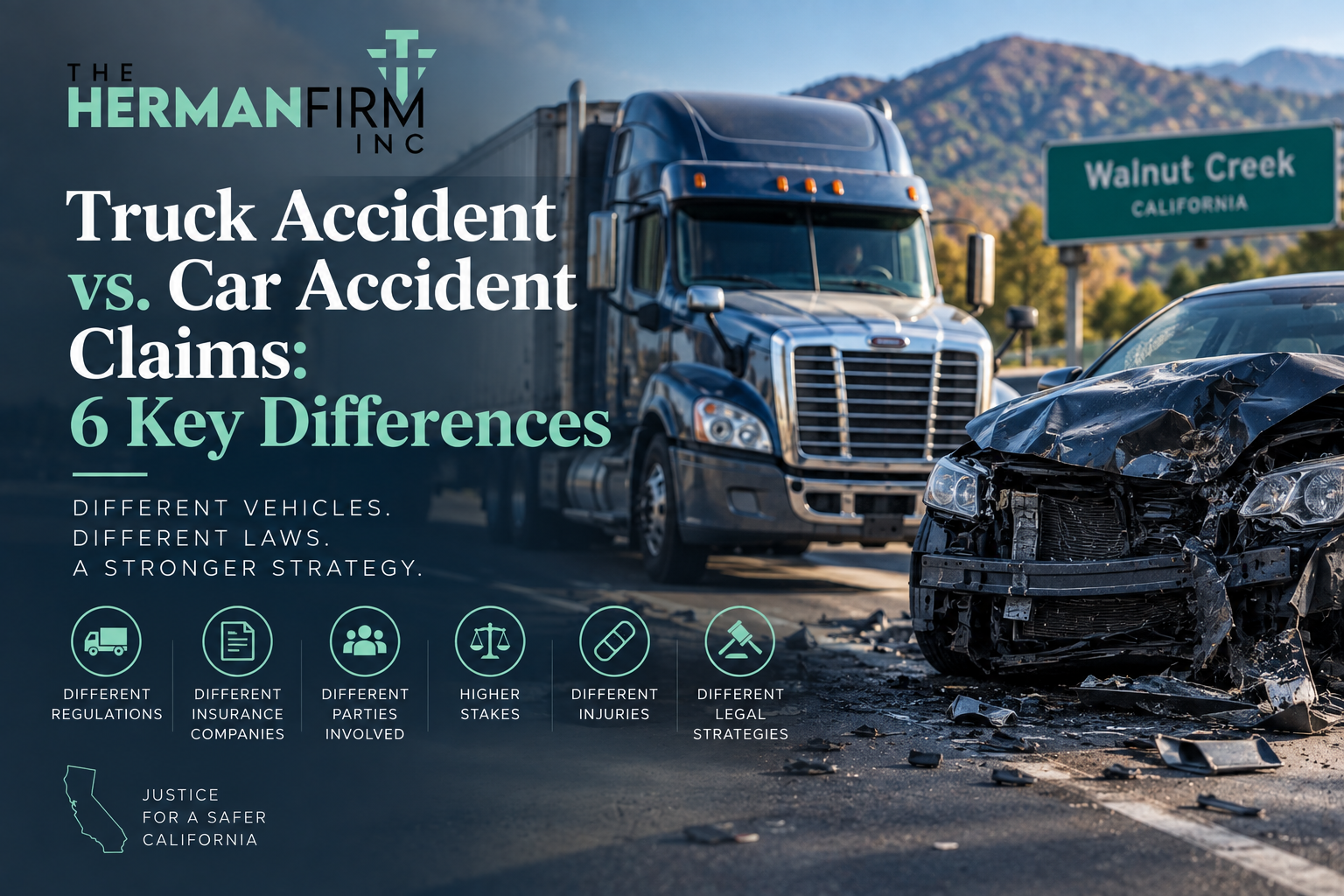
Truck Accident vs. Car Accident Claims: 6 Key Differences
A collision with a commercial truck is not simply a bigger version of a typical car accident. The vehicles involved, the companies behind them, the insurance coverage, and the evidence that determines fault all work differently. Understanding these differences matters because treating a truck accident claim like an ordinary car accident claim can leave real compensation on the table.
Truck accident claims differ from car accident claims in six major ways: the parties who can be held liable, the insurance policy limits involved, the federal regulations that apply, the evidence unique to commercial vehicles, the severity of injuries typically involved, and the investigation timeline required to preserve critical evidence. Because of these differences, truck accident cases generally call for faster action and a broader investigation than a routine car accident claim.
1. Multiple Parties Can Be Held Liable
In a typical car accident, liability usually comes down to one or two drivers. In a truck accident, liability can extend well beyond the driver to include the trucking company, the company that loaded the cargo, a maintenance contractor, or even the truck or parts manufacturer if a mechanical failure contributed to the crash. Identifying every potentially liable party is often the difference between a claim limited to one driver’s insurance policy and a claim that reaches multiple sources of coverage.
2. Insurance Policy Limits Are Much Higher
Commercial trucks are required to carry significantly higher liability insurance than passenger vehicles, often in the range of $750,000 to $1,000,000 or more depending on the cargo and vehicle classification, compared to California’s relatively low minimum liability requirements for personal auto policies. This higher coverage matters enormously in cases involving serious injuries, since a fully justified high-value claim can actually be paid rather than capped by an inadequate policy limit, which is a common problem in car accident cases involving minimally insured drivers.
Higher available coverage does not mean an easier claim. Trucking companies and their insurers typically deploy rapid-response investigation teams and defense attorneys immediately after a serious crash, specifically because more money is at stake.
3. Federal Regulations Create Additional Legal Theories
Commercial trucking is governed by Federal Motor Carrier Safety Administration regulations covering driver hours-of-service limits, vehicle maintenance and inspection requirements, driver qualification standards, and cargo securement rules. A violation of these regulations, such as a driver exceeding legal hours-of-service limits, can serve as independent evidence of negligence in a truck accident claim. Car accidents, by contrast, are governed primarily by state traffic law without this additional federal regulatory layer.
4. The Evidence Involved Is More Complex
Commercial trucks carry data and records that passenger vehicles typically do not: electronic logging device data showing hours driven, GPS tracking records, black box event data recorders, driver qualification files, maintenance logs, and pre-trip inspection reports. This evidence can establish fault with far more precision than the physical evidence typically available in a standard car accident, but it is also more likely to be lost, overwritten, or destroyed if not requested quickly.
5. Injuries Tend to Be More Severe
The size and weight disparity between a commercial truck and a passenger vehicle means that truck accident injuries are, on average, significantly more severe than typical car accident injuries. This affects nearly every part of a claim, from the amount of medical treatment required to the likelihood of permanent impairment, and it generally increases both the economic and non-economic damages at stake in the case.
Truck accident evidence disappears quickly. If you were involved in a collision with a commercial vehicle, time matters.
Get a Free Case Review6. The Investigation Must Move Faster
Because trucking companies often begin their own investigation within hours of a serious crash, and because critical electronic data can be automatically overwritten within days or weeks, truck accident cases generally require faster legal action than a routine car accident claim. Sending a formal evidence preservation letter, sometimes called a spoliation letter, as soon as possible after the crash can prevent key data from disappearing before your attorney has a chance to review it.
Side-by-Side Comparison
| Factor | Truck Accident Claim | Car Accident Claim |
|---|---|---|
| Potentially liable parties | Driver, trucking company, cargo loader, maintenance contractor, manufacturer | Usually one or two drivers |
| Typical insurance coverage | $750,000 to $1,000,000+ | State minimum to moderate policy limits |
| Governing regulations | State traffic law plus FMCSA federal regulations | State traffic law |
| Unique evidence | Electronic logs, black box data, maintenance records, inspection reports | Police report, photos, witness statements |
| Urgency of evidence preservation | High; data can be overwritten within days | Moderate; evidence generally more stable |
Comparative fault still applies in truck accident cases just as it does in car accidents, and it can significantly affect how much you recover. Our article on how percentage of fault affects a California car accident settlement explains how California’s pure comparative negligence rule works, which applies to both types of claims.
Frequently Asked Questions
Do I need a different type of lawyer for a truck accident than for a car accident?
Not a fundamentally different type, but you want an attorney with genuine experience in commercial truck cases specifically, given the federal regulations, multiple liable parties, and specialized evidence involved. See our guide on when you should hire a truck accident attorney for more on this.
How quickly should I act after a truck accident?
As soon as reasonably possible. Electronic logging data and other digital records tied to the truck can be overwritten or lost within days, so prompt evidence preservation requests matter significantly more than in a typical car accident claim.
Is the trucking company automatically responsible if their driver caused the crash?
Often yes, under a legal theory called vicarious liability, but the details depend on the driver’s employment status and the specific facts of the case. This is one of several reasons truck accident liability tends to be more complex than car accident liability.
Will my settlement be higher just because a truck was involved?
Not automatically, but higher available insurance coverage and often more severe injuries can support a higher claim value when the evidence supports it. Value still depends on your specific injuries, damages, and the strength of the evidence.
Involved in a Truck Accident?
Truck accident evidence disappears quickly. Every case at The Herman Firm gets direct attorney attention from the first call, and consultations are free.
Call 925-532-1977 Request a Free Case Review