

Personal Injury Law
California Personal Injury Statute of Limitations: How Long Do You Have to File a Claim?
If someone else’s carelessness left you injured, one deadline sits underneath everything else in your case: the statute of limitations. It is the legal time limit for filing a lawsuit, and once it passes, even a strong claim can be lost for good.
In California, the general rule is that you have two years from the date of injury to file a personal injury lawsuit. That is the starting point, not the whole story. Certain exceptions can shorten that window to as little as six months, and others can pause or extend it. Because the correct deadline depends on the type of claim, who caused it, when the injury became known, and other facts, waiting until the deadline is near is a real risk. This guide explains the general rule, the exceptions that change it, and the steps that protect your right to recover.
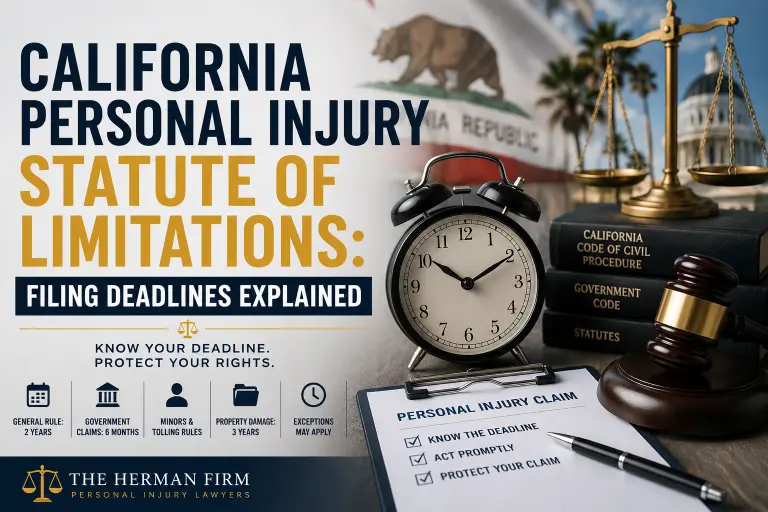
Under California Code of Civil Procedure section 335.1, most personal injury claims must be filed within two years of the date of injury. But that is a general rule, not a universal one. Claims against a government entity often must be presented within six months. Deadlines can be paused when the injured person is a minor, or when an injury could not reasonably have been discovered right away. Property damage generally follows a separate three-year deadline, and some claim types have their own rules entirely. The safest approach is to confirm your specific deadline early rather than assume two years applies.
What Is the Statute of Limitations for Personal Injury in California?
A statute of limitations is simply a legal deadline for bringing a claim. In California, personal injury claims are governed by California Code of Civil Procedure section 335.1, which generally sets a two-year limit for an action based on injury to, or the death of, a person caused by another’s wrongful act or neglect. In most cases, that two-year clock starts on the date the injury occurs.
If someone is injured in a car accident on June 1, the general two-year period may make June 1 two years later an important deadline. Even so, the precise deadline can depend on the facts and the applicable law, so this example will not fit every case.
The two-year rule covers many common situations, including car crashes, falls, and other accidents caused by someone’s negligence. But as the sections below explain, the deadline is not the same for every claim, and several circumstances can change it.
Does the Two-Year Rule Apply to Every California Injury Claim?
No. Treating “two years” as a fixed answer for every case is one of the most common and costly misunderstandings about California injury law. Depending on the circumstances, the deadline can be shorter, later, or governed by an entirely different statute.
Situations that can change the standard deadline include a claim against a government entity, an injured person who is a minor, an injury that was not reasonably discoverable right away, a responsible party who leaves the state, and claims for property damage rather than bodily injury. Certain categories of claims also follow their own rules. Medical malpractice, for example, is governed by a separate statute with its own timing. The point is not to memorize every rule, but to recognize that the correct deadline for your situation may not be two years, which is exactly why confirming it early matters.
What Is the Deadline for a Claim Against the Government?
When the party responsible is a public entity, such as a city, county, transit agency, or the state, the timeline is very different and much shorter. Under California Government Code section 911.2, a claim for personal injury or death against a government entity generally must be presented to that entity within six months after the cause of action accrues. This is a formal claim submitted to the government, and it is a required step before a lawsuit can move forward.
This shortened deadline matters most in cases such as:
- Crashes caused by a dangerous or poorly maintained public road.
- Falls caused by a defective public sidewalk.
- Injuries on other public property.
- Accidents involving a government vehicle, such as a city bus or a public works truck.
- Other claims where a public entity may be responsible.
Government claims also involve additional procedural requirements, and there are further deadlines that follow after a claim is presented or rejected. Because six months can pass quickly and the rules are strict, these claims should be handled promptly. The six-month requirement does not apply to every personal injury claim, but when a public entity may be involved, it can control the entire case.
What If the Injured Person Is a Minor?
California law treats children differently. Under California Code of Civil Procedure section 352, the time a person spends under the age of 18 generally does not count against the limitations period. In practical terms, the two-year clock for a minor’s personal injury claim is usually paused while they are a child and generally begins to run once they turn 18.
That said, this is not a blanket rule that gives every minor the same extra time. Important exceptions exist. Claims against government entities are generally not paused in the same way and can still require prompt action, and certain claim types, such as medical malpractice, follow their own separate timing rules for children. Because the details vary so much, anyone dealing with an injury to a child should get advice about the specific circumstances rather than assume a particular deadline applies.
What If the Injury Was Not Discovered Right Away?
Sometimes an injury, or its connection to someone’s wrongful conduct, is not obvious at the time of the event. California recognizes a delayed discovery rule for these situations. In general, the limitations clock may not start until the injured person discovers, or through reasonable diligence should have discovered, both the injury and that it was caused by another’s wrongdoing.
This can come up when:
- An injury seems minor at first and only later proves serious.
- A medical condition connected to an accident or exposure is diagnosed later.
- The link between the harm and the responsible conduct was not reasonably apparent at the time.
The delayed discovery rule is highly fact-specific, and it does not automatically extend every deadline. Whether it applies depends on what the injured person knew and reasonably should have known, and when. If you believe your injury surfaced later than the event that caused it, this is worth reviewing with an attorney rather than guessing.
What If the Person Responsible Leaves California?
Under California Code of Civil Procedure section 351, if the person responsible is absent from California, the time of that absence may not count toward the limitations period in some circumstances. The idea is that a defendant should not be able to run out the clock by staying out of reach.
This is not an automatic extension in every case. California courts apply section 351 narrowly, and it often does not help where the defendant can still be sued in California despite being physically absent, such as when a nonresident driver remains subject to the state’s jurisdiction. Whether a defendant’s absence affects your deadline is a careful, fact-dependent question, and it should never be assumed to buy extra time on its own.
How Long Do You Have to File a Property Damage Claim?
Injuries to your body and damage to your property follow different deadlines. Under California Code of Civil Procedure section 338, an action for taking, detaining, or injuring personal property, often called goods or chattels, generally has a three-year limitations period. That is longer than the standard two-year deadline for personal injury.
In practice, this distinction can matter after an accident that causes both types of harm. Damage to a vehicle, a bicycle, or personal belongings generally falls under the three-year property damage rule, while injuries to the person generally fall under the two-year rule. The two claims can arise from the same accident yet carry different deadlines, which is one more reason not to assume a single date governs everything.
What Is the Statute of Limitations for Wrongful Death?
When an accident is fatal, the family’s wrongful death claim has its own timing and should not simply be treated as identical to an injury claim. A wrongful death action in California is generally subject to a two-year deadline, but the clock typically runs from the date of death, which may not be the same as the date of the underlying accident. Other rules can also apply, including the shortened government-claim requirements when a public entity is involved.
Because these deadlines and the rules about who may file are specific, families should not rely on assumptions. Our guide on how a wrongful death claim is valued in California covers the broader picture, and speaking with an attorney early helps make sure a filing deadline is not missed during an already difficult time.
What Happens If You Miss the Statute of Limitations?
If a lawsuit is filed after the applicable deadline has passed, the claim can generally be barred. In most cases, the defendant will raise the statute of limitations as a defense, and the court will typically dismiss the case, which usually ends any chance of recovering compensation no matter how strong the underlying claim was.
That said, courts do not automatically dismiss every claim that looks late. Tolling rules, the delayed discovery doctrine, and other procedural issues can sometimes affect whether a deadline has truly expired. The takeaway is not to give up on a claim you assume is too old, and not to assume you still have time either. The correct deadline should be confirmed before drawing any conclusion.
Does Filing an Insurance Claim Stop the Statute of Limitations?
This is one of the most important practical points in this entire article. Reporting a claim to an insurance company, submitting a demand, or negotiating a settlement does not stop the statute of limitations from running. The legal deadline to file a lawsuit keeps ticking during all of it.
It is worth separating three things that often get blurred together. Making an insurance claim is a request for payment under a policy. Negotiating with an insurer is the back-and-forth over that claim. Filing a lawsuit is a separate legal action in court, and only that step stops the statute of limitations. Insurance negotiations can drag on for months, and a claim can still be open and active when the filing deadline arrives. If the deadline passes while you are still negotiating, the leverage to file suit can disappear entirely. This is exactly why the deadline should be tracked from day one, independent of any conversation with an insurer.
Not sure which deadline applies to your situation? A free, private case review can help you understand your options with no obligation.
Get a Free Case ReviewWhat Should You Do If You Were Injured in California?
Whatever the exact deadline turns out to be, a few steps protect both your health and your claim. If you are able to, focus on the following.
- Get appropriate medical care promptly, and follow through on treatment. This protects your health and documents the injury.
- Document the accident and your injuries while details are fresh.
- Preserve evidence, including photographs, video, incident or police reports, and anything connected to the accident.
- Keep your medical and financial records, including bills and proof of missed work.
- Identify the potentially responsible parties, since more than one may be involved.
- Consider whether a government entity may be involved, which can trigger the much shorter six-month deadline.
- Do not assume the standard two-year deadline applies to your situation.
- Speak with a qualified California personal injury attorney promptly, so the correct deadline is identified before it becomes a problem.
California Personal Injury Statute of Limitations by Accident Type
People often want a single deadline for their specific kind of accident, but the honest answer is that the applicable deadline depends on the legal basis of the claim and the circumstances, not simply on the label attached to the crash. Here is how the timing generally plays out across common case types.
- Car accidents. Generally two years from the date of injury under section 335.1, but a crash involving a government vehicle or a dangerous public road can trigger the six-month government-claim rule. See our Walnut Creek car accident overview.
- Motorcycle accidents. Generally the same two-year rule, with the same government exceptions where a public entity is involved. Learn more about motorcycle accident claims.
- Truck accidents. Generally two years, though these cases often involve multiple parties and insurers, which makes early evidence preservation important. See our truck accident page.
- Pedestrian accidents. Generally two years, with government exceptions when a public road or vehicle is involved. Our guide to California pedestrian accident claims covers how these cases are valued.
- Bicycle accidents. Generally two years, and a dangerous road or defective bike part can affect both liability and timing. Our article on bicycle accident fault and compensation in California explains more.
- Slip and fall accidents. Generally two years, but a fall on public property can trigger the six-month government-claim deadline. See our slip and fall page.
- Workplace injuries. These can involve separate systems, including workers’ compensation and third-party claims, each with its own deadlines. Our workplace injury overview explains the options.
- Wrongful death. Generally two years, but typically measured from the date of death, with government exceptions where applicable. Learn about wrongful death claims.
Frequently Asked Questions
How long do you have to file a personal injury lawsuit in California?
Generally two years from the date of injury under California Code of Civil Procedure section 335.1. This is the standard rule for most personal injury claims, but several exceptions can change it, so it should not be assumed to apply to every case.
Is the California personal injury statute of limitations always two years?
No. Two years is the general rule, but claims against a government entity often must be presented within six months, deadlines can be paused for minors or for injuries discovered later, property damage generally has a three-year deadline, and some claim types follow their own rules.
What is the deadline for suing a government entity in California?
A claim for personal injury or death against a public entity generally must be presented to that entity within six months under California Government Code section 911.2, followed by additional procedural deadlines. Because the window is short, these claims should be handled promptly.
Does filing an insurance claim extend the statute of limitations?
No. Reporting a claim, submitting a demand, or negotiating with an insurer does not stop the legal deadline. Only filing a lawsuit in court does that, so the deadline should be tracked separately from any insurance discussions.
What happens if I miss the personal injury filing deadline?
A claim filed after the deadline can generally be barred, and courts typically dismiss late claims. However, tolling rules and other issues can sometimes affect whether a deadline has truly passed, so the correct deadline should be confirmed rather than assumed.
Does the statute of limitations change if the injured person is a minor?
Often, yes. Under California Code of Civil Procedure section 352, time spent under 18 generally does not count against the deadline, so the clock usually begins when the child turns 18. Important exceptions apply, including for government claims, so specific advice is important.
What if I did not discover my injury immediately?
California’s delayed discovery rule may apply. In general, the clock may not start until the injured person discovers, or reasonably should have discovered, the injury and its connection to someone’s wrongful conduct. Whether it applies is highly fact-specific.
How long do I have to file a property damage claim in California?
Generally three years under California Code of Civil Procedure section 338 for injury to personal property such as a vehicle, bicycle, or belongings. That is different from the two-year deadline that generally applies to bodily injury.
How long do I have to file a wrongful death claim in California?
A wrongful death claim is generally subject to a two-year deadline, but the clock typically runs from the date of death, and government-claim rules can apply. Because the timing and eligibility rules are specific, these claims should be reviewed promptly.
Should I contact a lawyer before the statute of limitations expires?
Yes, and ideally well before. Identifying the correct deadline often requires analyzing the type of claim, the defendant, the injury, and when the claim accrued. Speaking with an attorney early leaves time to preserve evidence and protect your rights.
Not Sure How Long You Have? Talk to The Herman Firm
Deadlines in California injury cases are strict, and the right one is not always obvious. If you were hurt and are unsure about your timeline, the sooner you get clarity, the more options you have. Consultations are free, and you pay nothing unless we win.
Call 925-532-1977 Request a Free Case Review