

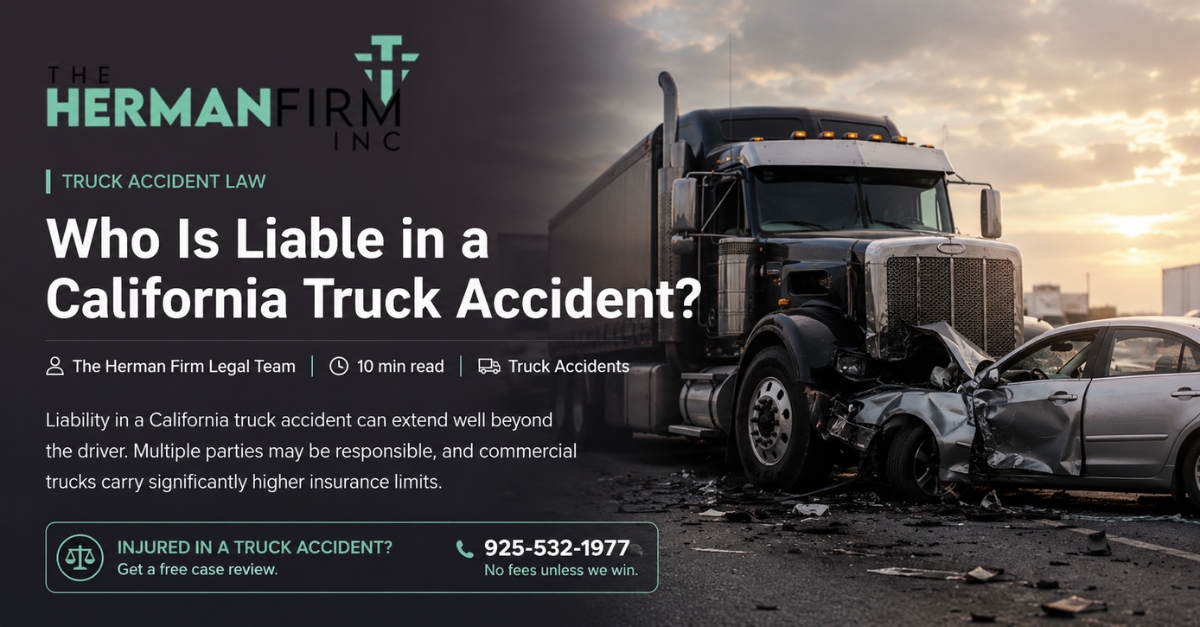
Truck Accident Law
Who Is Liable in a California Truck Accident?
When a passenger car gets hit by a fully loaded commercial truck, the injuries are rarely minor. An 18-wheeler can weigh twenty to thirty times more than the vehicle it strikes, and the physics of that mismatch are why truck crashes so often produce spinal injuries, traumatic brain injuries, and other harm that changes a person’s life. We’ve handled truck crash cases at The Herman Firm involving spine injuries, traumatic brain injuries, and knee injuries, and one thing is consistent across nearly all of them: figuring out who is actually responsible is more complicated than it looks on the surface.
Most people assume the truck driver is the only party who could be liable. In reality, a serious truck accident claim often involves several potentially responsible parties, each with their own insurance coverage. Identifying all of them is one of the most important things an attorney does in the early stages of a case, because it directly affects how much compensation is actually available to you.
Liability in a California truck accident can extend well beyond the driver. The trucking company, a cargo loading company, a maintenance contractor, a vehicle or parts manufacturer, and in some cases a freight broker can all bear responsibility. Commercial trucks are also required to carry far higher insurance limits than passenger vehicles, often between 750,000 dollars and 5 million dollars under federal law, which means more coverage may be available to compensate you than in a typical car accident claim.
Why Truck Accident Cases Are More Complex Than Car Accident Cases
A standard car accident claim usually involves two drivers and their respective insurance policies. A commercial truck accident operates under a completely different framework. Trucking companies are regulated by the Federal Motor Carrier Safety Administration, which means federal safety rules layer on top of California’s own traffic and negligence laws. Violations of these federal regulations can create powerful evidence of negligence that simply does not exist in an ordinary car crash case.
This added complexity is exactly why trucking companies deploy rapid response teams to serious crash scenes, sometimes within hours. Their goal is to control the narrative and secure favorable evidence before an injured victim has legal representation. Understanding who can be held liable, and moving quickly to preserve evidence, is essential to protecting the value of your claim.
Parties Who May Be Liable
The truck driver
Driver fatigue remains one of the leading causes of serious truck crashes. Federal hours-of-service rules limit how long a commercial driver can be on the road without rest specifically because drowsy driving in an 80,000-pound vehicle is exceptionally dangerous. Distracted driving, speeding, and driving under the influence are also common causes of driver-level negligence.
The trucking company
Under the legal doctrine of respondeat superior, an employer can be held liable for the negligence of its driver if the driver was acting within the scope of employment at the time of the crash. Beyond that, a trucking company can face independent liability for negligent hiring, inadequate training, poor supervision, or pressuring drivers to violate hours-of-service rules to hit delivery deadlines.
The cargo loading company
Improperly secured or unevenly distributed cargo is a common cause of rollover accidents and jackknife crashes. If a separate company was responsible for loading the truck, that company may bear liability if a loading error contributed to the crash.
Maintenance contractors and parts manufacturers
Brake failures, tire blowouts, and other mechanical malfunctions are sometimes traced back to defective repairs or defective parts rather than driver error. When that is the case, a maintenance contractor or manufacturer may share responsibility alongside the driver and trucking company.
Freight brokers
An emerging area of liability involves freight brokers who negligently hire carriers with poor safety records. California courts have shown increasing willingness to examine whether a broker’s failure to screen a carrier’s compliance history contributed to a crash.
Each potentially liable party may carry its own separate insurance policy. Identifying every responsible party is not just a legal formality. It can be the difference between a settlement limited by one thin policy and full compensation that accounts for the true cost of catastrophic injuries.
Federal Regulations That Strengthen a Truck Accident Claim
The Federal Motor Carrier Safety Regulations create specific, documented standards that trucking companies and drivers are required to follow. When a violation of these regulations is tied to a crash, it can support a strong negligence claim. The most frequently litigated violations include:
- Hours-of-service violations, which govern how long a driver can operate without mandatory rest periods
- Drug and alcohol testing failures, including pre-employment and random testing requirements
- Vehicle maintenance and inspection violations, including failure to properly maintain brakes and tires
- Weight and cargo securement violations, which can directly cause rollover and jackknife accidents
- Licensing and qualification violations, such as operating without a valid commercial license
Electronic logging device data, maintenance records, and driver qualification files are all discoverable evidence in a truck accident lawsuit, but trucking companies are not required to volunteer them. An attorney familiar with these cases knows exactly what to request and how quickly that evidence needs to be preserved before it disappears.
Injured in a crash involving a commercial truck? The evidence that proves liability starts disappearing within days. Get a free case review before you talk to the trucking company’s insurance adjuster.
Get a Free Case ReviewWhat Compensation Can a Truck Accident Claim Include?
Because truck accident injuries tend to be severe, and because commercial insurance policies carry significantly higher limits than personal auto policies, truck accident claims often carry substantially more value than an equivalent car accident case. A properly built claim accounts for:
- Past and future medical expenses, including surgery, rehabilitation, and long-term care for catastrophic injuries
- Lost wages and reduced future earning capacity
- Pain and suffering, based on injury severity and lasting impact
- Property damage to your vehicle
- Wrongful death damages, in cases involving a fatality
California places no cap on pain and suffering or economic damages in truck accident cases. That distinction matters, because it means the value of a serious claim is driven by the facts of the case and the strength of the evidence, not by an artificial ceiling imposed by state law.
How Long Do You Have to File?
Most truck accident claims in California must be filed within two years of the crash under Code of Civil Procedure 335.1. If a government entity, such as Caltrans or a public transit authority, contributed to the accident through a dangerous road condition, a much shorter six-month administrative claim deadline applies instead. Given the number of parties and insurance policies typically involved in a serious truck accident case, waiting to get legal representation almost always works against you.
Frequently Asked Questions
Is the trucking company always responsible if the driver caused the crash?
In most cases, yes. Under respondeat superior, an employer is generally liable for a driver’s negligence if the driver was acting within the scope of employment. There are exceptions, particularly involving independent owner-operators, which is why each case needs an individualized review of the driver’s employment relationship.
What if the truck driver was an independent contractor?
California’s ABC test under Labor Code 2775 makes it difficult for trucking companies to avoid liability simply by classifying drivers as independent contractors. Courts look closely at the actual working relationship, not just the label used in a contract.
How much insurance coverage is available in a truck accident case?
Interstate trucking companies are federally required to carry a minimum of 750,000 dollars in liability coverage, with many carriers holding between 1 million and 5 million dollars, particularly when hazardous materials are involved. This is significantly higher than the minimum coverage required for passenger vehicles.
Should I give a statement to the trucking company’s insurance adjuster?
No. Trucking company adjusters are trained to elicit statements that can be used to minimize your claim. Speak with an attorney before providing any recorded statement or signing any medical authorization requested by the trucking company or its insurer.
Injured by a Commercial Truck? Act Quickly.
Evidence in truck accident cases disappears fast, and the trucking company’s insurer is already building its defense. Let us start building your case. Consultations are free, and you pay nothing unless we win.
Call 925-532-1977 Request a Free Case Review