

Personal Injury Law
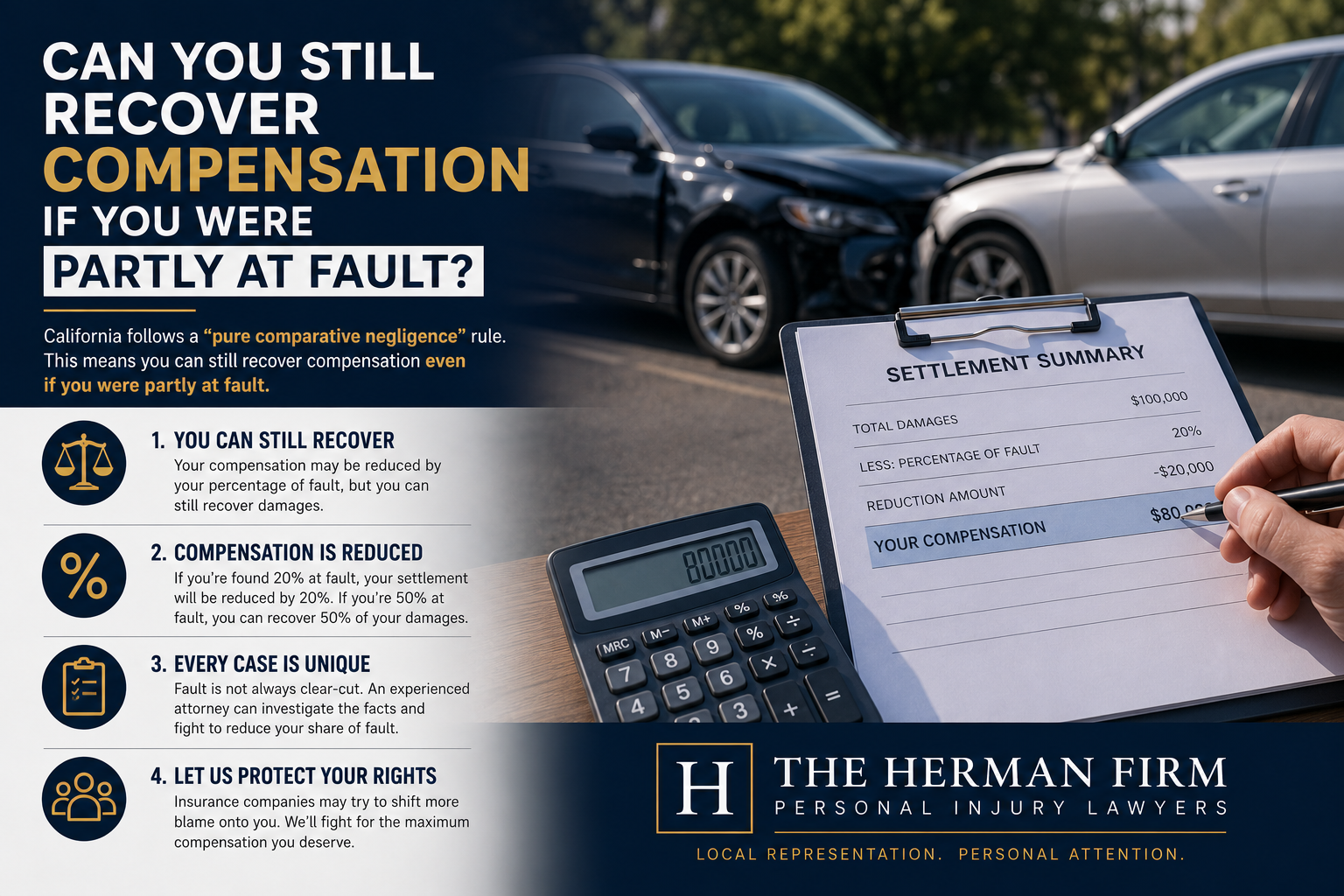
Can You Still Recover Compensation If You Were Partly at Fault?
One of the most common concerns we hear from injured clients is some version of the same question: what if I was partly to blame for the accident? Can I still file a claim?
It’s a fair question, and the good news is that in California, the answer is usually yes. California follows a rule called pure comparative negligence, which allows injured people to recover compensation even if they share some responsibility for what happened. Understanding how it works can help you make informed decisions about your claim.
Yes, in most cases. California uses a pure comparative negligence rule, meaning you can still recover damages even if you were partly at fault for an accident, as long as the other party bears at least some responsibility. Your compensation is simply reduced by your percentage of fault. Even someone found 90 percent at fault can still recover the remaining 10 percent of their damages. Insurance companies frequently try to inflate an injured person’s share of blame specifically to reduce what they owe.
What Is Comparative Negligence?
Comparative negligence is a legal doctrine used to divide fault, and financial responsibility, when more than one party contributes to an accident. Rather than treating fault as all-or-nothing, California law allows an insurance adjuster or a jury to assign a percentage of fault to each party involved.
For example, imagine a pedestrian is crossing outside a marked crosswalk and gets struck by a driver who was speeding. A jury might find the pedestrian 20 percent at fault for not using the crosswalk, and the driver 80 percent at fault for speeding. Under California’s pure comparative negligence rule, the pedestrian could still recover compensation, just reduced by their share of fault.
How “Pure” Comparative Negligence Works in California
California is one of a smaller group of states that follows a pure comparative negligence system, rather than the modified system used in many other states. This distinction matters a great deal.
In modified comparative negligence states, an injured person is barred from recovering anything once they’re found 50 or 51 percent at fault, depending on the state. California has no such cutoff. Even if you were found 99 percent at fault, you could still recover 1 percent of your damages, as long as the other party bears at least some responsibility.
If your total damages are valued at 100,000 dollars and you’re found 30 percent at fault, your compensation is reduced by that percentage, leaving a recovery of 70,000 dollars.
Why This Rule Matters for Your Claim
Insurance companies frequently use comparative negligence as a tool to reduce payouts, even when their policyholder bears the overwhelming majority of fault. Adjusters may point to minor factors, such as a slightly late reaction time or a decision that in hindsight could have been made differently, to argue that you share responsibility for the accident.
Because your compensation is directly tied to the percentage of fault assigned to you, disputes over comparative negligence can significantly affect the value of your claim. Every percentage point of fault shifted away from you can mean a meaningful difference in your final recovery, which is exactly why strong documentation and experienced representation matter.
Common Scenarios Where Comparative Negligence Comes Into Play
Comparative negligence arguments can arise in nearly any type of personal injury case, including:
- Car accidents, where fault might be split between two drivers, or a passenger’s own actions are questioned
- Pedestrian and bicycle accidents, where jaywalking or riding without a helmet may be raised as contributing factors
- Slip and fall cases, where a property owner may argue the injured person wasn’t paying attention
- Workplace accidents, where an employer may claim an employee failed to follow safety protocols
In each of these scenarios, the party being sued, and their insurance company, has a financial incentive to shift as much blame as possible onto the injured person.
Worried that being partly at fault means you have no case? It’s worth a second opinion before you assume the worst.
Get a Free Case ReviewHow an Attorney Can Help Protect Your Recovery
Because comparative negligence determinations can significantly impact your compensation, it’s critical to have someone in your corner who knows how to build a strong case and counter unfair fault allegations. An experienced personal injury attorney can:
- Gather evidence to establish the other party’s fault clearly and thoroughly
- Push back against inflated or unsupported fault allegations from insurance adjusters
- Bring in expert witnesses, such as accident reconstruction specialists, when needed
- Negotiate aggressively to minimize any fault attributed to you
- Take your case to trial if a fair settlement isn’t offered
Frequently Asked Questions
What is pure comparative negligence?
It’s a rule that lets an injured person recover compensation even if they were partly at fault for an accident, with the recovery reduced by their percentage of responsibility. California has no cutoff that bars recovery, unlike modified comparative negligence states.
How much will my settlement be reduced if I’m found partly at fault?
Your damages are reduced by whatever percentage of fault you’re assigned. If your damages are worth 100,000 dollars and you’re 25 percent at fault, you would recover 75,000 dollars.
Can I recover anything if I was mostly at fault?
Yes. Because California uses pure comparative negligence, you can recover a reduced amount even if you were found to be, for example, 80 or 90 percent at fault, as long as the other party bears some responsibility.
Why do insurance companies argue I was at fault?
Because every percentage of fault shifted onto you directly lowers what the insurer has to pay. Adjusters are trained to look for any argument, however small, that reduces the value of your claim.
Don’t Assume You Have No Case
Too many injured people assume that sharing some fault means they have no options. That’s rarely true under California law. Consultations are free, and you pay nothing unless we win.
Call 925-532-1977 Request a Free Case ReviewThis article is provided for general informational purposes only and does not constitute legal advice. Reading this post does not create an attorney-client relationship with The Herman Firm. Every case is different, and past results do not guarantee a similar outcome. For advice about your specific situation, please contact our office for a free consultation.